
- August 27, 2026
NANIA ENERGY ADVISORS • MARKET INSIGHTS
There Is Still Time for Onsite Solar…Maybe.
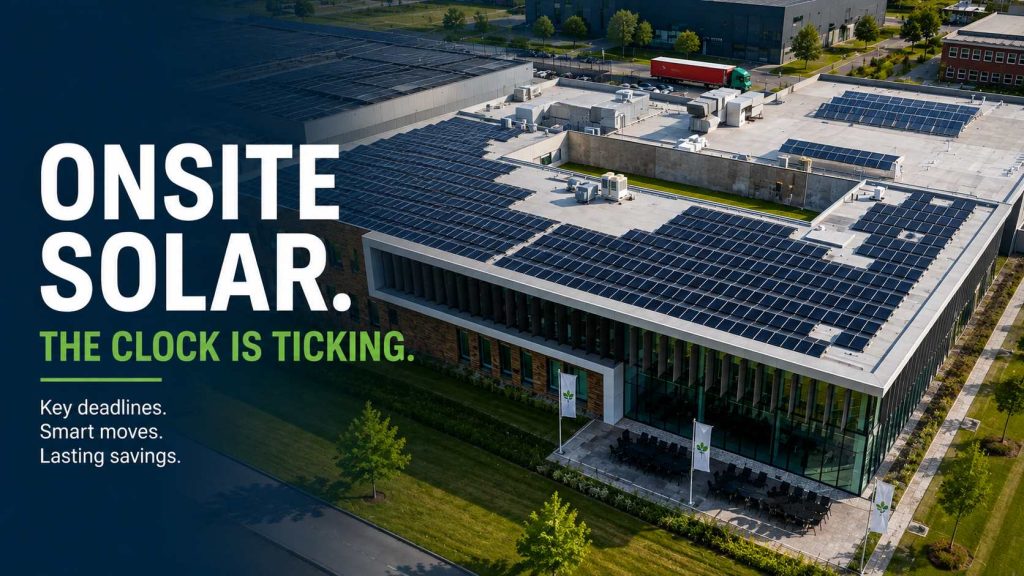
The federal tax credit landscape has changed. For commercial energy buyers, the opportunity isn’t necessarily gone — but the clock is ticking.
One of the main drivers of the economics behind onsite solar energy is the Federal Investment Tax Credit (ITC). These credits have been in place in some form since 1992 and were increased in 2005 to cover 30% of a project’s total cost.
Combined with the rising cost of electricity in the US, these tax credits have led to a rapid increase in the amount of solar energy being installed, especially onsite solar for commercial customers.
But the industry is at a crossroads.
So What Has Changed?
The Big Beautiful Bill that passed in 2025 significantly limited the ITC, but did not eliminate it entirely—at least not for commercial solar projects. Here’s what actually happened, and what it means for your business.
The Residential Side Is Gone
As of December 31, 2025, the residential solar investment tax credit (Section 25D) expired completely. Homeowners can no longer claim the ITC for customer-owned solar installations. This eliminates a major incentive that drove residential solar adoption for nearly two decades.
The Commercial Side: Two Critical Deadlines
For commercial, industrial, and municipal buyers, there is still hope. The commercial solar investment tax credit (Section 48) remains available, but it operates under two hard deadlines that will determine whether your projects qualify. Note that a project needs to meet only ONE of the following two deadlines:
COMMERCIAL SOLAR • TWO DATES TO KNOW
JULY 4, 2026
Construction begins
Projects that begin construction on or before this date qualify under IRS “safe harbor” status, as long as they are completed within four years.
OR
JULY 4, 2026
Construction begins
Projects that begin construction on or before this date qualify under IRS “safe harbor” status, as long as they are completed within four years.
Deadline #1: Construction Must Begin by July 4, 2026
To meet the first deadline, a project must begin construction on or before July 4, 2026. This is not a completion date—it is a start date. Projects that begin construction before the deadline qualify for the ITC under what the IRS calls “safe harbor” status, as long as they are completed within four years.
Deadline #2: Project Must Be In Service by December 31, 2027
Projects that begin construction after July 4, 2026, can still qualify for the ITC if they are placed in service by December 31, 2027. The definition of “in service” includes construction of the project, energizing of the system, and interconnection to the grid, which requires utility coordination and approval.
What Interested Buyers Should Do Right Now
If your organization is considering onsite solar, the window to capitalize on the ITC is closing. Here are the concrete steps to take to stay within it:
STEP 01
Start Your Feasibility Study Immediately
Begin with a solar feasibility study and ROI analysis to see whether solar makes sense for your facility—including a roof condition assessment, energy usage patterns, and a financial model showing how the ITC affects your payback period.
STEP 02
Issue an RFP for Your Onsite Solar Project
If the study meets your ROI threshold and usage reduction goals, issue an RFP to review developer quotes and create competition that drives down project costs. Quantify the ITC in your decision and get installation timeline commitments in writing.
STEP 03
Lock In Installation Timelines with Your Contractor
Begin conversations with installers now and commit to a start date as soon as possible. Contractor schedules will only tighten as the deadlines approach.
With electricity prices at historic highs and natural gas costs volatile, the economics for commercial solar are compelling—but only for a limited time. Solar contractors are busy, and they are about to get busier as the ITC deadlines approach. Don’t wait until your contractor is booked solid.
There Is Still Time—But Not Much
The economics for onsite commercial solar have never been stronger. Electricity prices are at historic highs, natural gas volatility threatens to push utility bills even higher, and the commercial ITC remains available—but only for projects that either begin construction by July 4, 2026, or are in service by December 31, 2027.
For commercial, industrial, and municipal energy buyers, the question is no longer whether solar makes sense—it’s whether you can get it done in time to qualify for the tax credit.
If your organization has been on the fence about onsite solar, the time to move is now.
Considering Onsite Solar?
Nania Energy Advisors can help evaluate onsite solar economics, run a competitive
RFP, and determine how a project fits within your broader energy strategy.
Nania Energy Advisors does not provide tax or legal advice. Organizations should consult their tax advisor regarding eligibility for federal tax credits.